
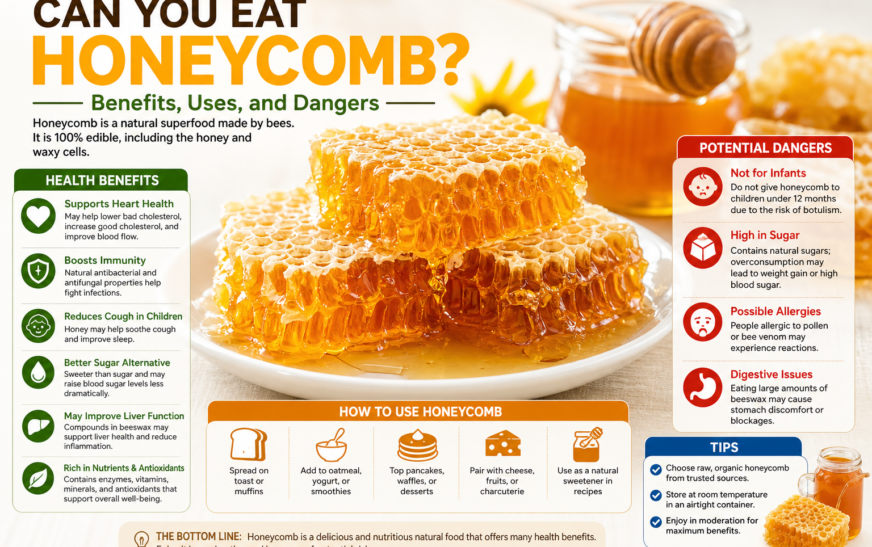
Raw honey can be eaten straight from the honeycomb, which is formed of beeswax. While drinking huge amounts may be detrimental to your health, there may be some health benefits, such as better heart or liver health.
For thousands of years, people have kept bees and consumed their honey.
One way to appreciate the result of bees’ labour is to eat honeycomb. A healthier liver and heart, as well as a decreased chance of infection, could result from doing this.
Eating honey straight from the comb, however, can potentially be dangerous.
The applications, advantages, and risks of honeycomb are examined in this article.
What Is Honeycomb?
Honey bees naturally produce honeycomb to shelter their larvae or store honey and pollen.
It is made up of several hexagon-shaped beeswax cells that are typically filled with raw honey.
Because it isn’t pasteurised or filtered, raw honey is different from commercial honey.
Additionally, some bee pollen, propolis, and royal jelly—additional bee products with potential health advantages of their own—may be found in honeycomb. These, however, are probably only present in trace amounts.
The entire honeycomb, including the surrounding waxy cells and honey, is edible.
Compared to filtered honey, raw honey has a more grainy consistency. The waxy cells can also be chewed like gum.
Bees naturally produce honeycomb to store their pollen, honey, and larvae. You can eat the entire honeycomb, including the raw honey and waxy cells.
Rich in Certain Nutrients
Antioxidants and carbs are abundant in honeycomb. A number of additional nutrients are also present in trace concentrations.
Its primary ingredient is raw honey, which contains 95–99% sugar and water but provides trace amounts of protein, vitamins, and minerals .
Raw honey has antimicrobial and antibacterial qualities due to the presence of enzymes like glucose oxidase.
The majority of commercial honey is processed by boiling and filtering, which destroys these enzymes .
Furthermore, compared to processed honey, raw honey typically contains more antioxidants and is less likely to be tainted with sugars like high-fructose corn syrup.
Antioxidants are health-promoting, anti-inflammatory, and disease-preventing plant chemicals. Raw honey may contain up to 4.3 times more of these than processed honey.
The primary antioxidant found in honey is polyphenols. They may help lower your risk of heart disease, diabetes, dementia, and possibly some types of cancer, according to research .
Beeswax, which delivers heart-healthy long-chain fatty acids and alcohols, is another ingredient in honeycomb. These substances have the potential to reduce cholesterol.
The two primary ingredients of honeycomb are raw honey and beeswax. While beeswax contains alcohols and long-chain fatty acids, raw honey is full of antioxidants and enzymes that may be good for your health.
May Promote Heart Health
Your heart health may be improved by honeycomb.
According to research, beeswax’s long-chain fatty acids and alcohols may lower high blood cholesterol, which is a heart disease risk factor.
Beeswax alcohols, for example, may help reduce “bad” LDL cholesterol by up to 29% while increasing “good” HDL cholesterol by 8–15%, according to one review.
It is challenging to determine if the tiny amounts of beeswax in honeycomb would have the same effects because the studies in this review used high concentrations of isolated alcohols generated from beeswax.
However, honey alone might be just as effective at lowering cholesterol.
Participants in one short trial were given 70 grams of honey or sugar each day. After 30 days, the honey group experienced a 3.3% increase in “good” HDL cholesterol and a 5.8% decrease in “bad” LDL cholesterol .
Additionally, substituting honey for sugar may help reduce triglyceride levels by as much as 19%
Antioxidants included in honey may also aid in widening the arteries that flow to your heart. Your risk of blood clots, heart attacks, and strokes may be decreased as a result of increased blood flow and decreased blood pressure .
Honeycomb may help your heart by lowering blood pressure, triglycerides, and “bad” LDL cholesterol while raising blood flow and amounts of “good” HDL cholesterol.
May Protect Against Infections
Your body’s capacity to combat specific germs and fungus may be strengthened by honeycomb.
For example, research conducted in test tubes indicates that beeswax extracts may provide defence against bacteria and fungi that cause illness, such as Salmonella enterica, Candida albicans, Staphylococcus aureus, and E. coli.
The antibacterial qualities of honey are also well-known. According to research, it might help shield your digestive system from the intestinal parasite Giardia lamblia.
However, to validate these effects, human research is required.
Your body’s defences against fungus and some bacteria that cause illness may be strengthened by honeycomb. Additionally, it might help shield your stomach from some parasites. But more human research is required.
May Reduce Coughing in Children
Children’s coughing may also be lessened by honeycomb.
Coughing is a common symptom of upper respiratory tract infections in children. Honey may help reduce this cough, according to research.
In one study, children’s coughing-related pain was lessened by consuming as little as 1/2 teaspoon (2.5 ml) of buckwheat honey half an hour before bed than by cough syrup.
Additionally, children who received buckwheat honey slept better than those who received cough medication or nothing at all .
Given its high honey content, honeycomb probably offers the same advantages.
Nevertheless, honey contains C. botulinum bacterial spores that can be harmful to infants. Because of this, children less than 12 months should not be given honey or honeycomb.
Children’s coughing may be lessened by the high honey content of honeycomb. However, because of the danger of botulism, it should not be administered to children younger than one year.
Potential Sugar Alternative for People With Diabetes
For those with diabetes, honeycomb might be a useful substitute for sugar.
This is partially due to the fact that honey is far sweeter than sugar, requiring smaller amounts to get the same sweetness. Furthermore, compared to refined sugar, honey seems to elevate blood sugar levels less.
However, honey still raises blood sugar levels, so diabetics shouldn’t eat too much of it.
Additionally, beeswax’s alcohols may help lower insulin resistance, a disorder that raises blood sugar levels.
Beeswax alcohol extracts were found to lower insulin levels by 37% in a small trial of individuals with nonalcoholic fatty liver disease (NAFLD), a condition in which fat builds up in the liver and is frequently accompanied by insulin resistance.
People with diabetes may benefit from these lower insulin levels since they may be a sign of decreased insulin resistance.
Remember that better research is required.
Compared to refined sugar, honeycomb often raises blood sugar levels less. Additionally, chemicals in honeycomb may help reduce insulin resistance, although further research is required.
May Improve Liver Function
Additionally, honeycomb may help maintain a healthy liver.
People with liver illness were given a mixture of beeswax alcohols every day for a period of 24 weeks. Interestingly, compared to just 8% of the placebo group, 48% of the beeswax group reported a reduction in symptoms like nausea, bloating, and stomach pain.
Furthermore, compared to none in the placebo group, liver function reverted to normal in 28% of those administered beeswax alcohols.
It’s unknown how much honeycomb you’d need to eat to have the same advantages, even if these results appear encouraging. Therefore, before firm conclusions can be drawn, more human research is required.
Honeycomb contains beeswax alcohols, which may enhance liver function and lessen liver disease symptoms. Nevertheless, further research is required.
How to Use It
There are several ways to consume honeycomb.
You may eat it on its own, but it’s a great spread for English muffins or warm bread. Additionally, honeycomb can be used to pancakes, cereal, yoghurt or handmade sweets as a sweetener.
Additionally, some people might like a slice of honeycomb on top of a salad or with aged cheeses, fruit, or charcuterie.
Honeycomb can be purchased online, but you can probably find it at your neighbourhood farmers market or health food store.
When selecting honeycomb, remember that the darker the honey, the more antioxidants and other healthy chemicals it contains.
At room temperature, honeycomb can be stored for a long time. It is more likely to crystallise the longer you store it, but the crystallised form is still edible.
Honeycomb can be added to a number of recipes as a side dish or used as a sweetener. Honeycomb should be kept at room temperature and is probably available at your neighbourhood farmers market.
Potential Dangers
In general, honeycomb is regarded as safe to consume.
It is susceptible to contamination by C. botulinum spores, nevertheless, because it contains honey. Pregnant women and infants younger than a year old are especially at risk from these .
Eating a lot of honeycomb might occasionally result in gastrointestinal blockages.
It could be wise to avoid consuming a lot of honeycomb every day or just spit out the waxy cells to reduce the chance of this occurring.
Additionally, honeycomb may trigger an allergic reaction in those who are allergic to pollen or bee venom.
Honeycomb is generally regarded as safe to eat in moderation. However, because of the risk of botulism, you should not feed it to your baby or consume it while pregnant. It’s also advisable to avoid overindulging in honeycomb due to the high sugar content of honey.
What Is Honeycomb Cereal?
Honeycomb cereal is a popular breakfast cereal made by Post Consumer Brands. It’s known for its large, crunchy, honeycomb-shaped pieces and sweet honey flavor.
Ingredients & Nutrition
Unlike real honeycomb, this cereal is processed and usually contains:
- Corn flour
- Sugar & corn syrup
- Oats
- Artificial or natural flavors
- Small amounts of vitamins and minerals (fortified)
While it has a “honey” taste, it does not contain actual honeycomb wax.
Pros of Honeycomb Cereal
- Quick and convenient breakfast
- Crunchy texture kids enjoy
- Often fortified with vitamins (like iron & B vitamins)
- Affordable and widely available
Cons to Know
- High in sugar → not ideal for daily consumption
- Low in fiber compared to healthier cereals
- Highly processed
- Can spike blood sugar quickly
How to Eat It Better
If you like Honeycomb cereal, you can make it healthier:
- Add milk + nuts + seeds
- Mix with high-fiber cereal
- Top with fresh fruits like bananas or berries
Honeycomb Cereal vs Real Honeycomb
| Feature | Honeycomb Cereal | Real Honeycomb |
|---|---|---|
| Source | Processed food | Made by bees |
| Sugar | High added sugar | Natural sugars |
| Nutrients | Fortified | Natural enzymes & antioxidants |
| Wax | ❌ No | ✅ Yes (edible) |
| Health value | Moderate | Higher (in moderation) |
The Bottom Line
A natural bee product, honeycomb is made up of hexagon-shaped, waxy cells that contain raw honey.
In addition to being tasty, honey and its comb have several health advantages, including enhancing heart health and preventing infections. Additionally, honeycomb may improve liver function and provide diabetics with an alternative to sugar.
Nevertheless, honeycomb should only be eaten in moderation because it still contains a lot of sugar.
For More Information Visit our Homepage: